Industrial Material Flow Systems for Modern Manufacturing Plants
- snzritech
- Apr 16
- 6 min read
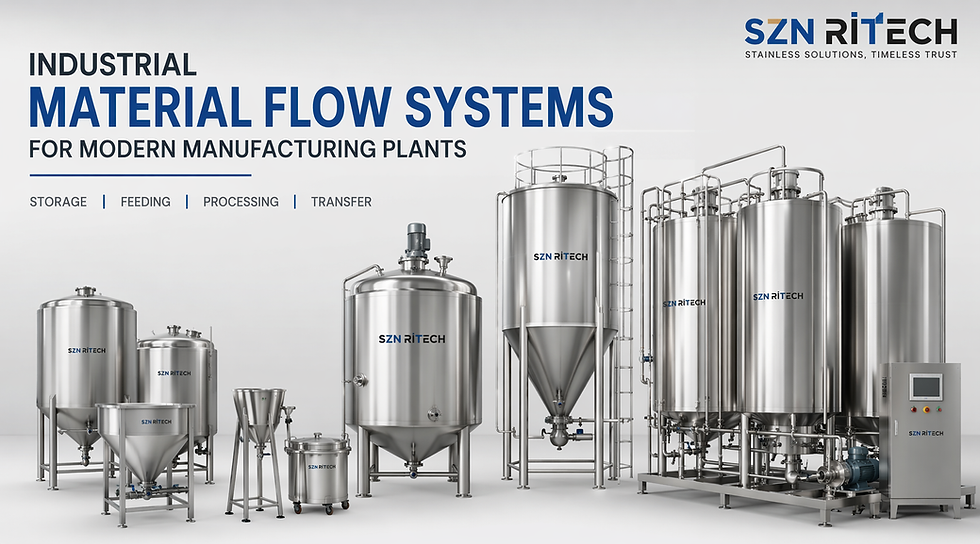
Modern industrial production depends on efficiency, consistency, and hygiene. Across sectors such as pharmaceuticals, food processing, chemicals, agriculture, and manufacturing, companies require fully integrated systems that manage materials from raw input to final output. An industrial material flow system is a complete setup that connects storage, feeding, processing, and transfer equipment into one continuous workflow. Instead of relying on isolated machines, modern factories use stainless steel storage tanks, hoppers, processing tanks, and transfer systems to automate production and reduce operational inefficiencies.
This page explains how a complete system works and helps you choose the right industrial equipment for your production needs.
What is an Industrial Material Flow System?
An industrial material flow system is an engineered production structure designed to manage materials through every stage of manufacturing.
It typically includes:
Bulk storage systems for raw materials
Feeding systems for controlled input
Precision dosing systems
Processing tanks for mixing and reaction
Storage tanks for intermediate or final products
Transfer systems for movement between stages
This integrated approach ensures continuous production, reduces contamination risks, and improves operational efficiency.
Bulk Storage Systems for Industrial Applications
Bulk storage is the first stage of any manufacturing process. It involves storing large quantities of raw materials safely and efficiently.
Industrial bunker and silo storage systems
Industrial bunker and silo storage systems are designed for high-capacity storage of bulk industrial materials such as powders, granules, chemicals, and raw ingredients. They are widely used in agriculture for grain and feed, chemical manufacturing for raw materials, construction for cement and powders, and food industries for bulk ingredient handling. These systems ensure efficient storage, automated discharge, reduced manual handling, contamination protection, and uninterrupted supply to production lines.
Applications include:
Agriculture (grain and feed storage)
Chemical manufacturing (raw material storage)
Construction (cement and powders)
Food industry (bulk ingredients)
Key benefits:
Large-scale storage capacity
Automated discharge systems
Reduced manual handling
Contamination protection
Continuous supply to production lines
Feeding Systems for Controlled Production Flow
Feeding systems regulate the movement of materials from storage units into production lines, ensuring accuracy, consistency, and stable industrial operations. These systems are essential for maintaining uninterrupted workflows in automated manufacturing environments. By controlling material input, they reduce errors, improve efficiency, and support continuous production processes across various industries requiring precision and reliability.
Industrial hopper systems
Industrial hopper systems are designed to control the flow of powders, liquids, and semi-solid materials into processing equipment. They ensure smooth and regulated discharge, preventing inconsistencies in production lines. Hoppers are widely used in automated manufacturing systems to improve efficiency and maintain steady material flow across different industrial applications.
Key functions
Key functions of feeding systems include ensuring consistent material flow, preventing blockages in production lines, supporting automated manufacturing systems, and reducing material waste and spillage. These functions help maintain operational stability, improve production efficiency, and ensure smooth integration with downstream processing equipment in industrial environments.
Used in
Feeding systems are widely used in pharmaceutical manufacturing, chemical processing, food production, and plastic and polymer industries. These sectors rely on precise material handling and controlled feeding mechanisms to maintain product quality, ensure consistency, and support large-scale automated production processes.
Precision Material Dosing Systems
Precision material dosing systems are used in industries that require highly accurate measurement and controlled handling of raw materials. These systems ensure precise ingredient distribution in automated production lines, improving consistency and reducing errors. They are widely used in pharmaceutical, chemical, food, and cosmetic manufacturing processes where exact formulation and dosing accuracy are critical for product quality.
Material cups for industrial manufacturing
Material cups are precision dosing components used in industrial manufacturing systems to achieve controlled, residue-free discharge of materials. They enable accurate batching of powders, liquids, and semi-solid ingredients in automated production environments. These systems are essential in industries that require strict formulation control, ensuring uniform output and minimizing material loss during processing.
Advantages
Key advantages of precision dosing systems include high dosing accuracy, reduced formulation errors, improved batch consistency, and efficient handling of sensitive or high-value ingredients. These benefits support reliable production processes, enhance product quality, and reduce operational waste, making them essential for modern automated industrial manufacturing systems.
Applications
Precision material dosing systems are widely applied in pharmaceuticals, cosmetics manufacturing, specialty chemical production, and food additive processing. These industries depend on accurate measurement and controlled ingredient handling to maintain compliance, ensure product safety, and achieve consistent quality across large-scale manufacturing operations.
Industrial Processing Tanks for Mixing and Reaction
Processing tanks are the core of industrial production systems. They transform raw materials into finished or semi-finished products.
Stainless steel mixing and reaction tanks
These tanks are used for:
Mixing multiple ingredients
Heating and cooling processes
Chemical reactions
Temporary storage
Why stainless steel is preferred:
Corrosion resistance
Hygienic and easy to clean
High-temperature durability
Long operational lifespan
Suitable for aggressive chemicals
Industries served:
Chemical manufacturing
Food and beverage processing
Pharmaceutical production
Cosmetics industry
Oil and industrial fluids
Smart Industrial Storage Systems with Automation
Smart industrial storage systems with automation represent the next generation of manufacturing infrastructure, integrating intelligent control technologies into stainless steel storage tank and intelligent instrument. These systems use real-time monitoring to optimize industrial processes, improve efficiency, and ensure precise control over stored materials. They are widely adopted in industries requiring high accuracy, safety, and continuous production management.
Smart stainless steel storage tanks
Smart stainless steel storage tanks are equipped with advanced sensors and automation systems that enable real-time monitoring and control of industrial processes. These tanks are designed for modern manufacturing environments where precision, efficiency, and data-driven operations are essential for maintaining consistent production quality.
Features
Key features of smart storage systems include temperature monitoring, pressure control, level detection systems, and automated process integration. These features enable continuous tracking of industrial conditions, ensuring stable performance, reduced risk of failure, and improved operational efficiency across manufacturing systems.
Benefits
The benefits of smart industrial storage systems include improved operational safety, reduced human intervention, real-time production control, and higher efficiency and accuracy. These advantages help industries streamline operations, minimize errors, and achieve consistent production outcomes in automated environments.
Common industries
Smart stainless steel storage systems are widely used in the pharmaceuticals, biotechnology, and high-precision chemical production industries. These sectors rely on advanced automation and monitoring systems to maintain strict quality standards, ensure safety compliance, and support complex manufacturing processes.
Industrial Transfer Systems: Turnover Barrels
Industrial Transfer Systems: Turnover Barrels
Industrial transfer systems play a critical role in manufacturing workflows by ensuring safe, controlled, and efficient movement of materials between production stages. Turnover barrels are an essential part of this system, enabling seamless transfer of liquids, powders, and semi-processed materials in automated and hygienic industrial environments. They improve workflow continuity and reduce handling risks across production facilities.
Stainless steel turnover barrels
Stainless steel turnover barrels are portable industrial containers designed for the safe transportation of liquids, powders, and semi-processed materials between different stages of production. These containers are widely used in industries requiring hygienic and contamination-free material handling, ensuring durability, safety, and operational efficiency in material transfer processes.
Benefits
Key benefits of turnover barrel systems include easy movement between production stages, hygienic closed-system transfer, reduced contamination risk, and flexible production logistics. These advantages help improve operational efficiency, maintain product integrity, and support smooth material flow in automated industrial manufacturing systems.
Applications
Turnover barrels are widely used in food ingredient transfer, pharmaceutical liquid handling, and chemical batching systems. These applications require precise, safe, and contamination-free material movement, making turnover barrels an essential component in modern industrial production environments.
Complete Industrial Material Flow Workflow
A fully integrated system operates in a continuous cycle:
Raw materials stored in bulk storage systems
Hoppers regulate controlled feeding
Material cups ensure precise dosing
Processing tanks handle mixing and reactions
Smart tanks monitor and optimize conditions
Turnover barrels transfer materials between stages
Final storage or packaging completes production
Industries That Use Industrial Material Flow Systems
Pharmaceutical and biotechnology
Sterile environments
Controlled formulation processes
Precision manufacturing systems
Food and beverage
Dairy processing
Beverage production
Ingredient storage systems
Chemical industry
Industrial mixing and reactions
Acid and alkali processing
Raw material handling
Agriculture and bulk materials
Grain storage systems
Fertilizer handling
Feed processing
Oil and industrial fluids
Lubricant storage
Fuel processing systems
Industrial oil blending
Why Choose Integrated Stainless Steel Systems
An integrated material flow system improves industrial operations by:
Reducing production downtime
Improving material consistency
Enhancing hygiene and safety standards
Supporting automation and scalability
Lowering long-term operational costs
Stainless steel systems remain the industry standard due to their durability, hygiene, and resistance to corrosion.
Conclusion
Industrial material flow systems are the backbone of modern manufacturing. By integrating storage tanks, feeding systems, processing equipment, and transfer solutions into a unified workflow, industries can achieve higher efficiency, safety, and production consistency. From bulk storage to final transfer, every stage plays a critical role in ensuring seamless industrial operations. Businesses that invest in integrated stainless steel systems gain long-term operational advantages and improved production reliability.


Comments